They Were All Tech Guys: How History's Greatest Preachers Used Cutting-Edge Technology
Before you write off church tech as a distraction from "real ministry," meet the pastors who went all-in on the technology of their day — and changed the world because of it.
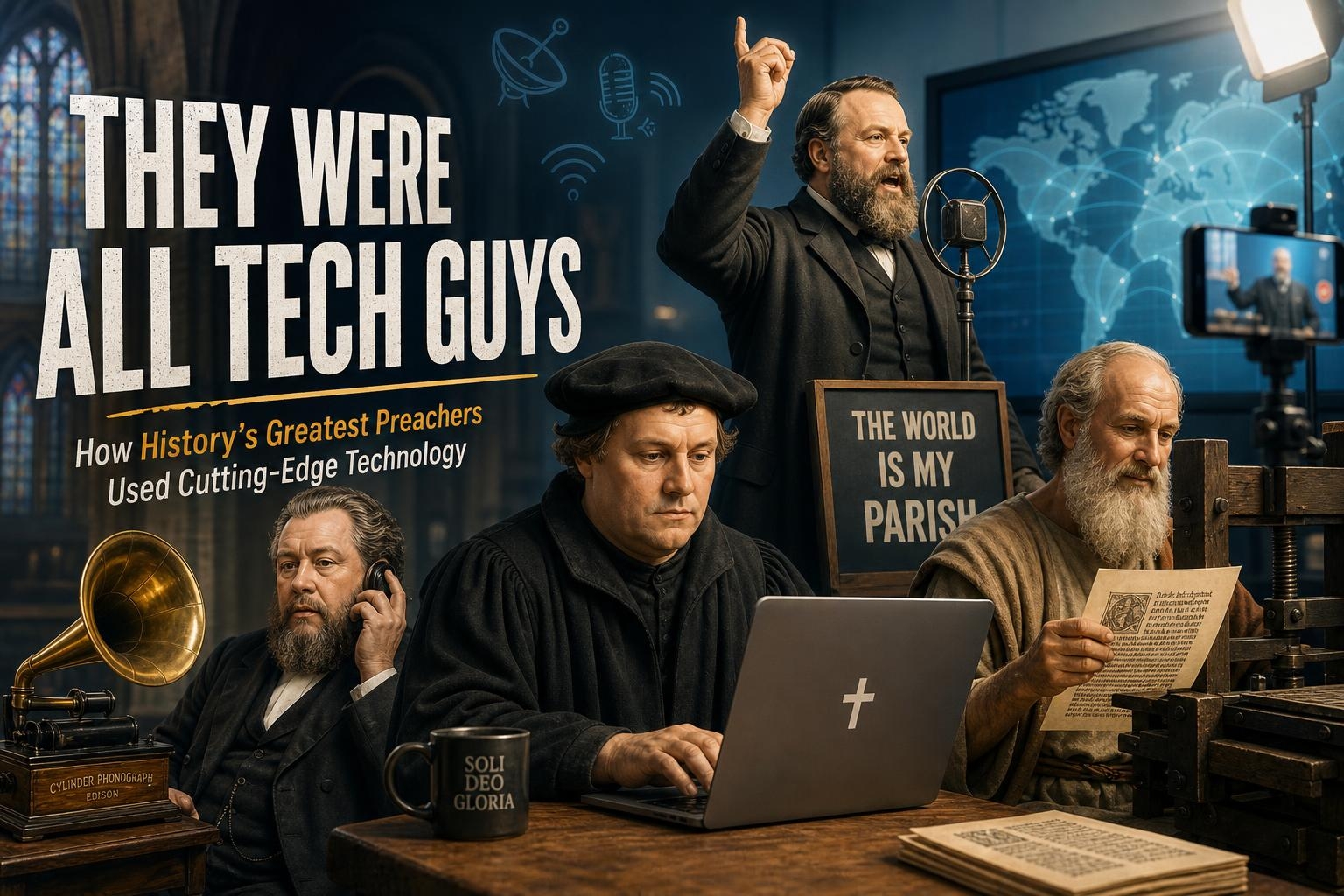
Every now and then, someone pulls me aside after a Sunday service and says something like, “You know, I just feel like all this technology is getting in the way of real ministry.” And I get it — I really do. There’s something that feels spiritually serious about simplicity.
But here’s the thing: the giants of church history didn’t feel that way. Not even a little.
The preachers and theologians we put on pedestals — the ones whose books are still in print, whose sermons are still quoted, whose ideas literally reshaped Western civilization — were, every single one of them, aggressive adopters of the best communication technology available to them. They didn’t tolerate it. They ran toward it.
Martin Luther and the First Viral Moment in History
Let’s start with the big one.
When Martin Luther nailed his 95 Theses to the door of the Wittenberg Castle Church in 1517, that was actually a pretty normal thing to do. Academic debate invitations got posted to church doors all the time. Under normal circumstances, a few local scholars would have argued about it for a while and moved on.
But Luther didn’t live in normal circumstances. He lived 75 years after Gutenberg’s printing press changed everything.
Within two weeks, copies of the 95 Theses had spread across Germany. Within two months, they were all over Europe. Luther himself was reportedly stunned. He wrote that it was “almost a pity” the theses had spread so fast — he hadn’t even finished thinking some of them through.
He figured it out quickly, though. Luther became the most published author in Europe almost overnight. He wrote in German — not Latin — specifically because he wanted regular people to read his work. He understood his audience. He understood his medium. He understood distribution.
Martin Luther was, without exaggeration, the first viral media figure in recorded history. And he used every bit of that reach on purpose.
John Calvin: The Man Who Built a Publishing Infrastructure
Calvin doesn’t get enough credit for this. While Luther was the firebrand, Calvin was the systems guy.
Geneva, Switzerland, under Calvin’s influence, became a printing powerhouse. He worked with trained scribes, established relationships with printers, and built a distribution network that pushed his Institutes of the Christian Religion across the entire European continent. This wasn’t accidental. Calvin understood that ideas don’t spread themselves — you need infrastructure.
Think about that the next time someone complains that your church spends money on a content management system or a social media scheduler. Calvin literally built a city’s publishing industry around theological distribution. He’d have had strong opinions about your church’s email open rates.
Jonathan Edwards: Working the 18th-Century Algorithm
Jonathan Edwards is best known for “Sinners in the Hands of an Angry God,” which — fun fact — he reportedly delivered in a quiet, nearly monotone voice while reading from a manuscript. The power wasn’t in his delivery style. It was in the content, and in how it traveled.
Edwards was a meticulous correspondent. He maintained formal letter networks across the colonies and across the Atlantic. His published sermons were copied and distributed by post riders — the 18th-century equivalent of a content distribution network. He understood that a sermon preached once in Northampton, Massachusetts didn’t have to stay in Northampton, Massachusetts.
He also carefully documented and published accounts of the revivals happening around him, which spread the news of what God was doing and fueled more revival. He was, in modern terms, doing content marketing for the Great Awakening.
Charles Spurgeon: The Victorian Podcast
This one might be my favorite.
Charles Spurgeon preached to thousands every week at the Metropolitan Tabernacle in London. But he wasn’t content to let those sermons die in the room. He hired stenographers — actual human beings whose entire job was to transcribe his sermons in real-time as he preached.
Those transcripts were then edited, typeset, printed, and mailed. Every week. To over 25,000 subscribers around the world.
Twenty-five thousand. Weekly. In the 1800s. Without electricity, without the internet, without a single social media platform.
Spurgeon’s sermons eventually filled 63 volumes. They’re still in print. He understood something that a lot of church communicators still struggle with today: the message doesn’t stop mattering when the service ends. Get it out. Get it moving. Put it in people’s hands.
He’d have had a podcast. It would have been the most downloaded podcast in history.
The Pattern Is Hard to Miss
Every one of these men looked at the most powerful communication technology of their era and said, essentially, yes, and how do we use more of it?
None of them treated technology as a threat to authentic ministry. They treated it as a gift — a tool for getting the Word further, faster, into more hands and more hearts.
Proverbs 22:29 says, “Do you see someone skilled in their work? They will serve before kings.” These men were skilled. They took the tools seriously. And their work outlasted them by centuries.
So the next time someone suggests that caring about your church’s tech is somehow less spiritual than other kinds of ministry work — you’ve got a pretty solid historical counterargument.
Luther, Calvin, Edwards, Spurgeon. All tech guys. All in.
You’re in good company.