Your Church's Audio Doesn't Need to Be Recorded at 96kHz to Sound Good
Tech volunteers obsessing over sample rates are solving a problem that doesn't exist. Here's why 16-bit/44.1kHz is more than enough — and where to actually focus your energy.
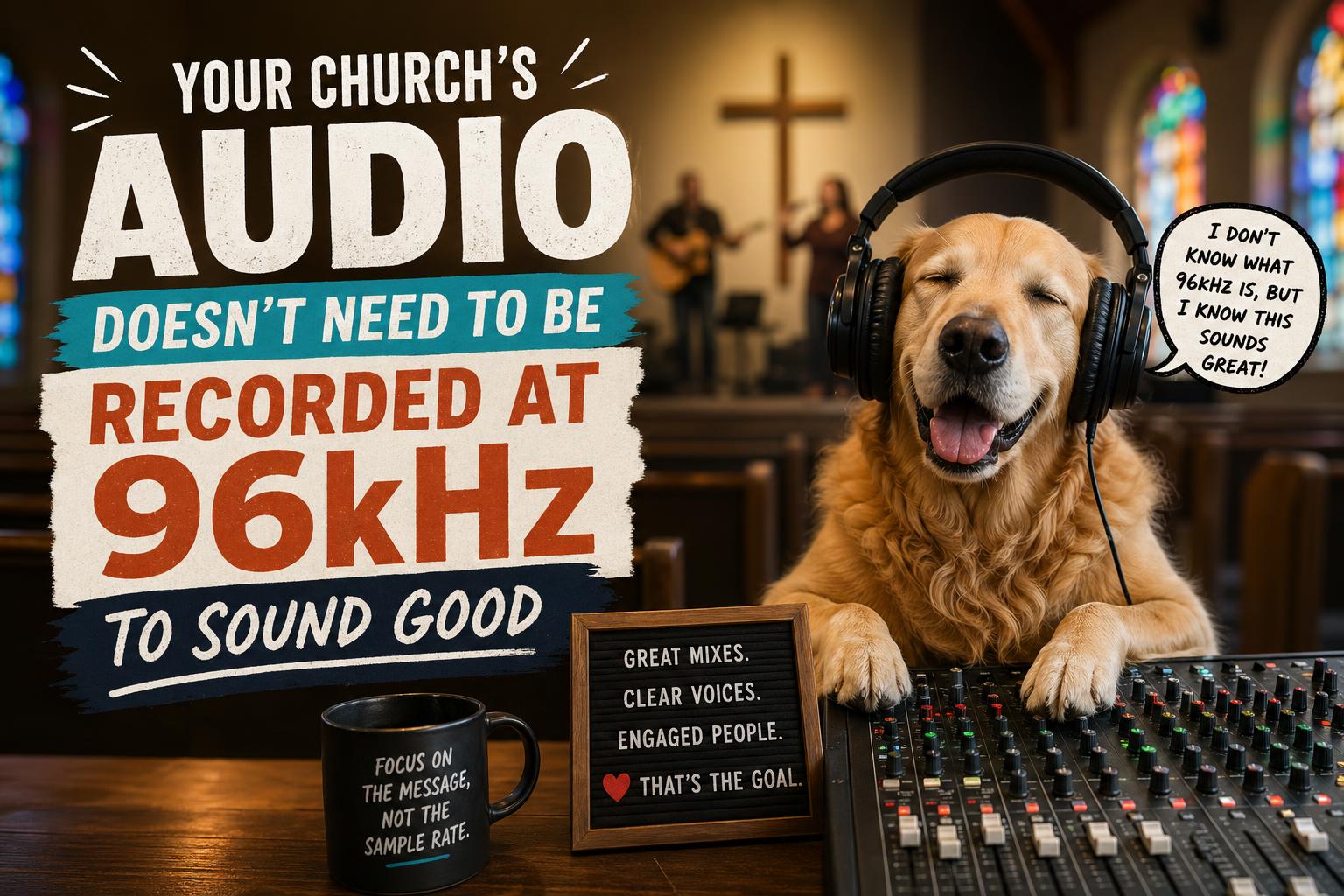
Every few months, someone in the AV booth discovers that the recording software is set to 16-bit/44.1kHz and panics. “We need to bump this up to 32-bit float and 96kHz — we’re losing quality!” And suddenly a perfectly good Sunday morning workflow is in crisis mode over a setting that, honestly, was never the problem.
I get it. When you care about the quality of what your church puts out, you want to do it right. That instinct is good. But sometimes caring a lot leads us to optimize the wrong things. This is one of those times.
What 44.1kHz Actually Means
Sample rate is how many times per second the audio is “sampled” — essentially, how many snapshots the system takes of the sound wave. At 44.1kHz, that’s 44,100 snapshots per second.
Here’s the thing: the human ear can only hear frequencies up to about 20,000 Hz (20kHz). That’s the ceiling for basically every human on the planet, and most adults start losing the top end of that range somewhere in their 20s and 30s. (Occupational hazard if you’ve been running sound for a while, honestly.)
The Nyquist theorem — a foundational principle in digital audio — tells us that to accurately reproduce a frequency, you need a sample rate at least twice that frequency. So to capture 20kHz, you need at least 40kHz. At 44.1kHz, you’ve got headroom to spare. CD-quality audio has been the standard since 1982 for a reason. It covers everything the human ear can perceive, with room to breathe.
What 16-Bit Means for Dynamic Range
Bit depth controls dynamic range — the difference between the quietest and loudest sounds in a recording. Each bit gives you roughly 6dB of dynamic range.
16-bit audio gives you 96dB of dynamic range.
To put that in perspective: a whisper is around 30dB. A live rock concert is around 110–120dB. The dynamic range of a typical church service — even a loud one with a full band — sits comfortably within that 96dB window. And your congregation’s ears aren’t sitting in an acoustically perfect listening environment anyway. There’s HVAC noise, room reflections, a toddler somewhere in row four.
96dB of dynamic range is not a limitation. It’s plenty.
”But What About 24-Bit and 96kHz?”
Higher sample rates and bit depths do have legitimate uses — mostly in professional recording studios where engineers are doing heavy processing, pitch correction, time stretching, and stacking dozens of tracks. In those workflows, the extra headroom gives you more to work with before things start degrading.
But here’s the practical reality for most churches: you’re recording a sermon, a worship set, or a livestream. You’re not running 80 tracks through a mastering chain. The difference between 16/44.1 and 24/96 in that context is not something your congregation will ever hear. What they will notice is if the pastor’s mic has a ground hum, the worship leader’s in-ear monitor is feeding back, or the livestream audio is 200 milliseconds out of sync with the video.
Those are the problems worth solving.
Where to Actually Spend Your Energy
If you want better audio quality in your church, here’s where the real gains are:
- Mic placement — A well-placed dynamic mic beats a poorly placed condenser every time.
- Gain staging — If your signal is clipping at the preamp, no sample rate will fix that.
- Room treatment — Hard floors, bare walls, and a low ceiling will ruin audio that was recorded at 96kHz just as fast as 44.1kHz.
- Consistent monitoring — Use headphones in the booth. Know what your mix actually sounds like, not what you think it sounds like.
- Cable quality and signal path — Noise introduced before the signal hits your interface doesn’t care about your sample rate.
These are the unglamorous, unsexy things that actually move the needle.
A Word to the Gear-Hungry Volunteer
If you’re the person in the booth who loves digging into specs and settings — your church needs you. That curiosity is a gift. But don’t let the pursuit of perfect become the enemy of good, especially when “good” is already more than sufficient.
Proverbs 14:23 says, “All hard work brings a profit, but mere talk leads only to poverty.” There’s a version of that in the AV world: tinkering with settings you don’t need to change is not the same as doing the work that actually improves the sound.
Your congregation doesn’t know what sample rate you’re running. They just know whether they could hear the sermon clearly. Start there.
The Bottom Line
16-bit/44.1kHz is not a compromise. It’s not “good enough for church.” It is genuinely, scientifically, perceptually sufficient for human hearing — the same standard that has delivered music into people’s homes and cars for over 40 years.
Set it, trust it, and go fix your gain structure. That’s where the real work is.