Bill Had One Eye and He Taught Me Everything I Know About Church Camera Work
Before you spend your whole camera budget on a camera, read this. A retired Hollywood grip with one eye changed the way I think about video in the church.
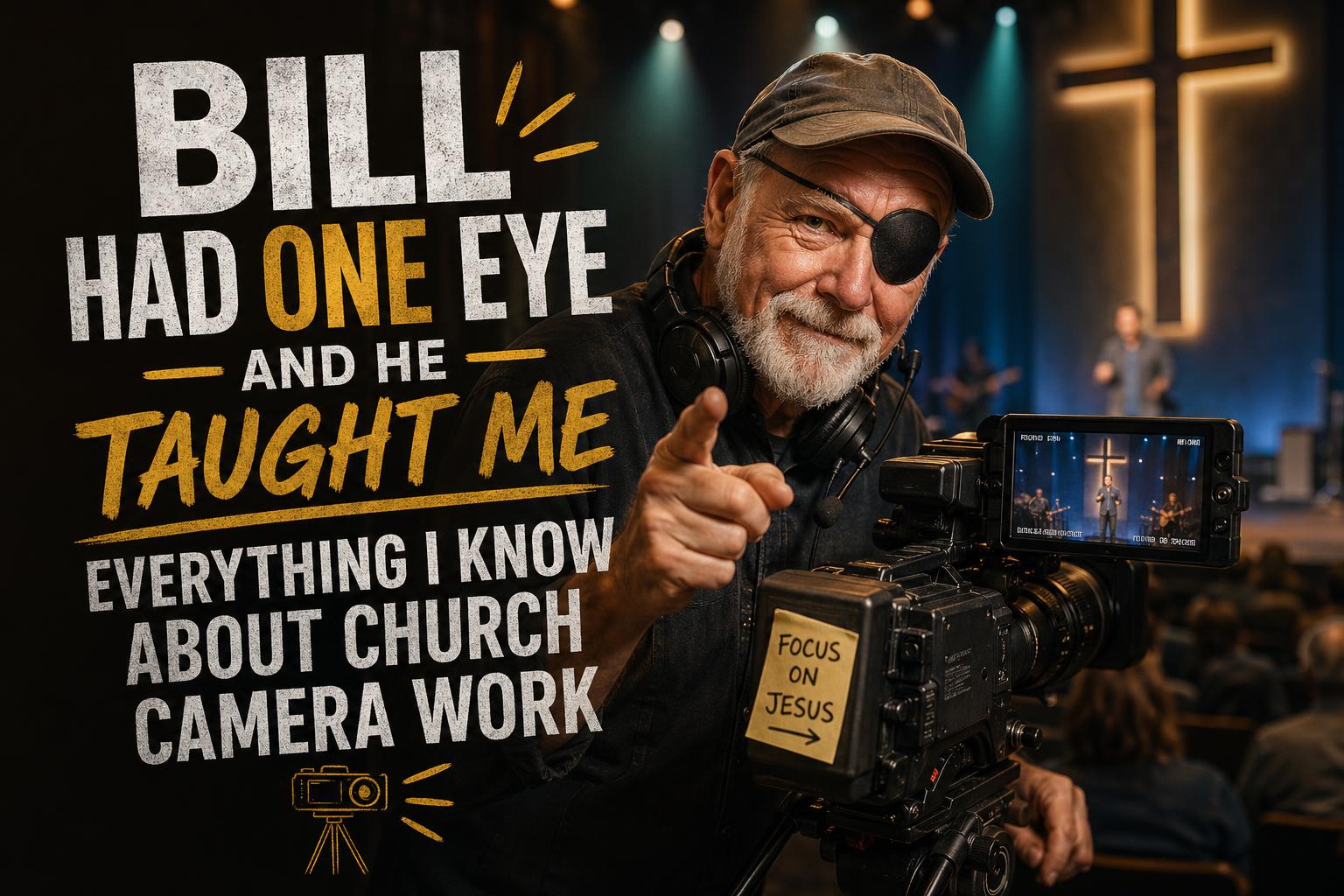
When Bill showed up to volunteer at our church, I was a little nervous.
Not because he seemed difficult — he was actually one of the friendliest guys you’d ever meet. I was nervous because of his resume. Bill had spent his career as a grip on big-budget Hollywood film productions. And I figured when he got a look at our setup, he’d hand me a list of equipment we couldn’t afford and a polite expression that said “bless your heart.”
That’s not what happened.
Bill looked around, asked a few questions, and told me we could make a real difference with lights from Home Depot if we had to. He wasn’t being dismissive. He just understood something that most people in church AV take years to figure out: the light matters more than the camera.
The Line I’ve Never Forgotten
At some point during one of our early conversations, Bill made an observation that I’ve repeated probably a hundred times since.
He said the camera only has one eye — just like him.
Bill had lost an eye at some point in his life. He said it with a completely straight face and then smiled. That was Bill. But underneath the joke was one of the most clarifying things anyone has ever said to me about video production.
We have two eyes. They work together to give us depth, dynamic range, and the ability to adapt to a room full of mixed, imperfect light without even thinking about it. Walk from a bright lobby into a dim sanctuary and your eyes adjust in seconds. You barely notice.
A camera doesn’t do that. It has one sensor, one lens, and one fixed response to whatever light you point it at. It can’t compensate the way your eyes can. It can’t blend a warm stage wash with cool house lights and make it look natural. It sees exactly what’s there — and if what’s there isn’t good, the camera will show you every bit of it.
Good lighting doesn’t just make things look pretty. It gives the camera something it can actually work with.
The Most Expensive Mistake in Church Video
Here’s the scenario I run into more than almost anything else when I’m talking to churches about their video setup.
Someone decides it’s time to improve the quality of their livestream or their in-room camera shots. They do their research, watch the YouTube comparisons, read the specs, and land on a camera that’s genuinely a solid choice. They spend their entire budget on it. They mount it in the back of the room, plug it in, and the footage looks… fine. Maybe a little better than before. But not the dramatic improvement they were hoping for.
The camera isn’t the problem. The light is.
Cameras are easy to get excited about. The specs are tangible. The comparisons are fun to watch. Lighting feels less exciting — it’s harder to understand, harder to shop for, and honestly just less glamorous than a new camera body. So the camera gets the money and the lighting gets whatever’s left over.
Usually nothing.
And then everyone wonders why the footage still looks flat.
What the Camera Is Actually Seeing
When the lighting in your room isn’t set up with the camera in mind, a few things happen — and none of them are good.
Faces go flat. Without a dedicated front light aimed at your subject, the camera sees a face lit from above by house lights, which creates shadows under the eyes and chin that make people look tired or washed out. Your eyes compensate for this automatically. The camera does not.
Backgrounds compete. If the background behind your speaker or worship leader is brighter than their face, the camera exposes for the background and the person goes dark. You’ve seen this — the preacher looks like a silhouette in front of a glowing screen. It happens because the camera can only expose for one thing at a time.
Color temperature fights itself. Warm stage lighting mixed with cool house lighting mixed with daylight coming through windows is a mess that your eyes sort out without effort. The camera picks one color balance and everything else looks wrong. Skin tones go orange or green. The stage looks like a different world than the rest of the room.
None of these problems get solved by a better camera. They get solved by light.
What Intentional Lighting Actually Does
You don’t need a Hollywood budget to fix this. Bill made that clear. But you do need a plan.
A few things make an immediate difference:
Front light on your subjects. Get dedicated light aimed at the faces of the people your camera is going to be on — your pastor, your worship leader, your speakers. This is the single biggest improvement most churches can make. It gives the camera a well-lit subject to expose for and everything else falls into place around it.
Separation from the background. A little light aimed at the background behind your subject — or simply making sure the background isn’t brighter than the subject — creates depth and keeps your camera from fighting itself on exposure.
Consistent color temperature. Pick a color temperature and commit to it for everything the camera sees. Mixing warm and cool sources is the fastest way to make footage look cheap, even if the camera is expensive. Modern LED fixtures make this easier than it’s ever been — you can dial in a specific Kelvin value and match it across every light in the rig.
You don’t have to go overboard. A modest, well-planned lighting investment will do more for the quality of your video than doubling your camera budget.
Before You Buy the Camera
If you’re in the middle of planning a camera upgrade right now, do this first: walk into your room and look at the light. Not the cameras. The light.
Look at where the shadows fall on faces. Look at what’s brighter than what. Look at whether your stage wash and your house lights are fighting each other on color temperature. Look at what the camera is actually going to see.
Then figure out what a basic lighting improvement would cost — some front light on your subjects, some color temperature consistency — and build that into your budget alongside the camera, not as an afterthought.
Bill could have shown up at our church and made us feel like amateurs. Instead he showed up, looked around, and started solving problems with what we had. He understood that the goal was never the gear. The goal was the image — and the image starts with the light.
He only had one eye. But he saw more clearly than most people I’ve ever worked with.